Wynncraft version 1.20, released 20 January 2021, which rebuilt territory warfare from the ground up around guild war towers, a five-resource guild economy, headquarters and taxed trade routes — and abolished territory XP, the economic basis of the alliance order that preceded it.
Version 1.20, titled 'Gavel Reborn', was released on 20 January 2021[1][2]. Alongside housing, raids and a large Gavel rework, it replaced the guild war system that had stood since the Guild Update of December 2014, and is the largest single mechanical break in the history of territory warfare. The full changelog had been published two months earlier, on 23 November 2020[3].
What changed
Wars stopped spawning waves of mobs on dedicated war servers. In their place, attackers were sent to an arena containing a 'Guild Tower' — a boss the attacking party had to defeat — which the defending guild could buff with resources and special abilities at a continuing hourly cost[4]. Wars were also moved off separate servers into ordinary game worlds[5].
Holding land now produced five resources — emeralds, wood, ore, fish and crop. A captured territory could be designated a Headquarters, toward which surplus resources flowed territory by territory, and from which upgrades were paid outward across the empire. Guilds set tax rates on other guilds' trade routes crossing their land, could improve individual territories at an hourly cost, and could have their routes cut off by an enemy; guilds could also ally to exchange tributes at a reduced tax rate[6][7]. Attacking a territory now cost emeralds — initially either the guild's or the attacker's own[5]. Elsewhere the update added a guild bank, a Strategist rank able to buy tower upgrades and territory bonuses, four-letter guild tags, a territory map on the L key, and raised the cost of creating a guild to 20 LE[8].
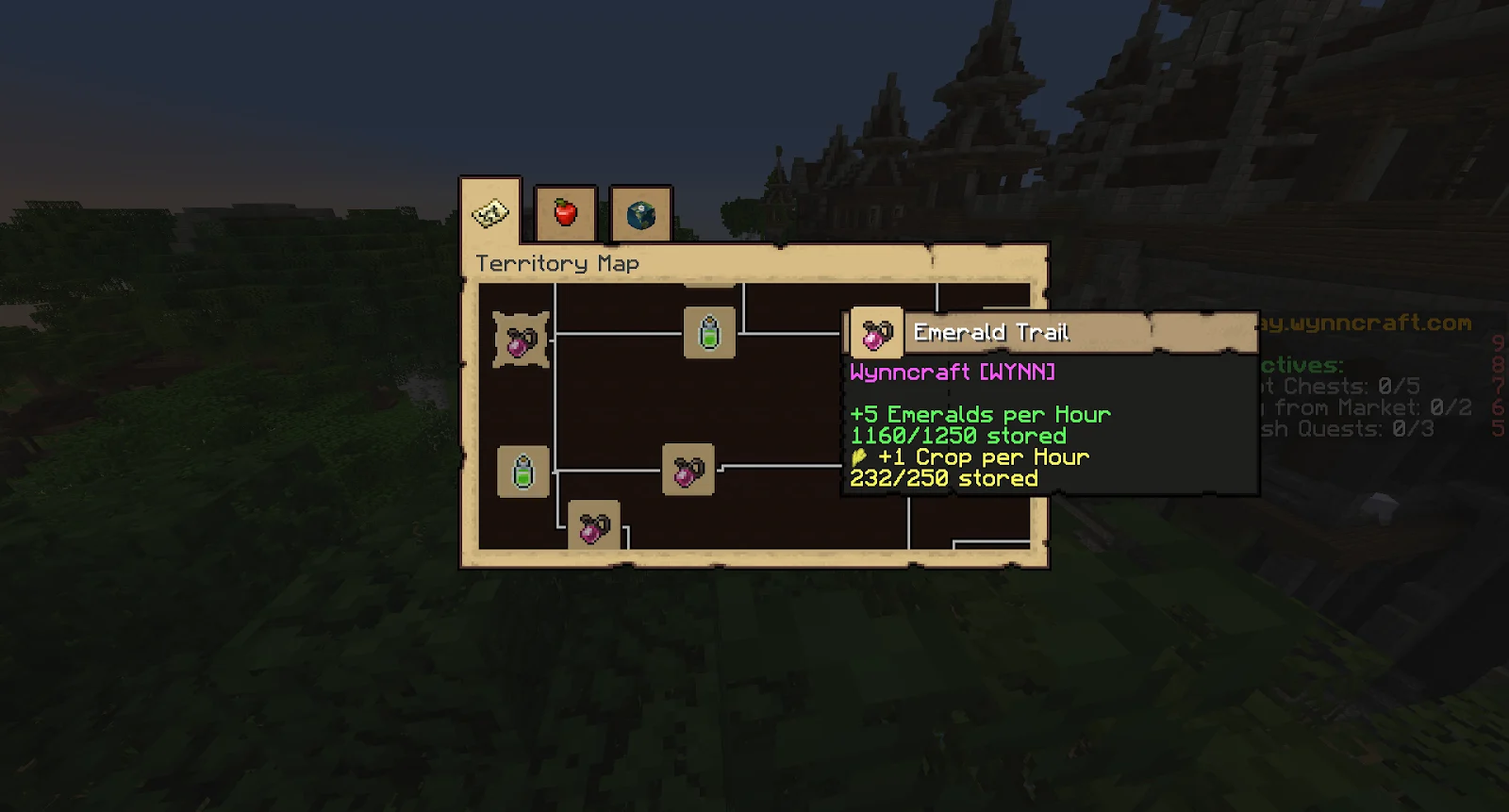 Official Wynncraft promotional screenshot for 1.20 showing the in-game Territory Map: connected territories, and a tooltip for Emerald Trail held by the guild Wynncraft giving its emerald and crop production rates.
The most consequential line in the changelog was one sentence long: 'Territories no longer generate XP.'[5][8] XP became a purchasable per-territory bonus instead[9].
Design intent
The changelog stated the goal plainly: to 'allow large guilds to have a stable hold of some territories without needing to play 24/7 to defend it, and also give a chance for newcomers to get started without getting instantly destroyed by a guild with 80 territories'. It also named, in advance, the problem the community would spend the next month arguing about: “We're suspecting the first major problem we'll find will be unbreakable alliances. It'll depend on how easy it is to break those alliances and how greedy allies will be.”[10]
Reception
The update landed in the middle of the Goose-Artemis war, one day after the first written use of the name Goose[11], and the warring community's response split along the lines of that war rather than settling into a single verdict.
The first sustained critique came from xMini_ of Aequitas, whose thread 'The Problem With 1.20 Guild Wars' opened on 22 January 2021[12]. He argued that headquarters-distance timers had shut warfare down across the map — 'If we were to try and attack Lava Lake, the timer to start the war would be more than 40 minutes' — and that abolishing territory XP had killed the free-for-all fighting that sustained day-to-day warring: 'Now with the 1.20 wars, there are no FFA's as terrs no longer give xp (another dumb idea). So basically its at a point now where you aren't warring unless you're being attacked.' He also mourned the political order the rework was meant to loosen: 'mega alliances are what made warring in Wynn fun and exciting in the first place. Now that it's gone, a lot of the action and excitement is gone', and noted that subguilds — 'some subs even became their own guild, thus diversifying the warring community' — had lost their function. He wrote from inside the winning bloc: “Look at Goose right now. We have the large majority of the map.”[13]
A month later Eragon, posting for Empire of Sindria, made the opposite argument from the losing side, in 'The Issue With 1.20 Guild Wars': that the rework had failed to break monopolies at all. 'If a mega alliance is already in control of the map then, there is no real chance for smaller guilds to ever hold a territory longer than the cool down… yesterday we were warring in Rymek, and after we had taken 4 territories, the price went up from 4096 emeralds to 24k emeralds.' He added that towers now favoured wealth — 'the only way a guild can reliably take out any guild tower medium defense or above is if that war team is equipped with mythics' — and concluded that 'the guild update shifted from repetitive wars and an environment where it was hard to establish smaller guilds on the map, to an uncreative "build meta" and an environment where it is nearly impossible to establish smaller guilds on the map'[14].
He was answered point by point by 99loulou999 of The Dark Phoenix, then in Goose, who defended the system as a diplomatic game rather than a military one — 'Why would a smaller guild hold a territory by themselves if guild wars are a team game where diplomacy is the key?' — and attributed the Rymek price spike to a mass assault: 'every guild in artemis except probably 4 were warring the whole desert/savanah/rymek area currently held by Rays, so its normal that after 5h of constant warring the "pity price" (which nobody understands so far) rose up.' He also recorded the tax settings the community had converged on within a month: 'everyone's tax are on 80% for non ally and 1% for ally'[15]. Rothboy of Eden argued the update had worked as designed — '1.20 successfully made it easier for smaller guilds to get on the map, that was the objective all along' — citing Idiot Co and Profession Heaven holding land under Goose, and claimed the two blocs had simply read the new system at different speeds: 'Goose understood it and got the map asap while artemis failed to understand it and adopted the strategy to wait'[16]. DeathLucifer of TheNoLifes dismissed the whole genre of complaint — 'Stop using small guilds as a political tool' — observing that the objectors had not raised the issue while their own side held the map[17].
The war-cost reversal
One criticism produced a change. IceResistance, founder of Titans Valor, opened 'War Costs + Balances' on 31 January 2021, arguing that the update had turned guilds into 'Wynncraft's new money sink': 'In order to participate in the new war system, your members are forced to dish out their own emeralds — as if the new 20 le guild cost wasn't bad enough.' He also argued that the option was self-defeating even for those who used it, since paying from personal emeralds bypassed timers, taxes and route planning entirely[18]. He later added a single line at the top of the post: 'UPDATE: This has been changed, and the entire system is completely free to use now.'[19]
The change came in the update's sixth hotfix, which removed personal-emerald attacks, made a landless guild's first attack free, and replaced the flat cost with a scale rising from 256 emeralds at one territory to 4,096 at four or more; the same hotfix cut tower upgrade prices, set a ten-minute post-capture immunity, and required three days' guild membership before warring[20]. IceResistance returned on 24 February to argue that the surviving 'pity cost' — the escalating price charged to guilds attacking a defender that was losing land quickly — had outlived its purpose: 'With personal le warring gone, pity is obsolete.' He reported prices 'upwards 44k+, again before tax'[21].
Consequences
By removing territory XP, 1.20 removed the thing territorial claims had been for. Under the previous system a held territory generated XP for its holder, which is what made claims worth defending and made the free-for-all hotspots worth grinding[5]; the alliance layer of 2019 and 2020 was built on distributing and protecting that income (see the alliance wars of 2019 and the Artemis-Goose era). Neither camp in the February 2021 argument thought the rework had ended alliance dominance: the pro-alliance critic and the anti-monopoly critic agreed that the map was still held by a bloc, and disagreed only about whether that was a fault[13][14]. Both Goose and Artemis nonetheless collapsed on the same day less than four months later, on 11 May 2021 (the Great Collapse).
The systems introduced here define the modern game: the tax-and-route economy is still the basis of the attack-cost formula[22], the ally setting introduced in the same update became the subject of the Diplomacy update, and patch 1.20.3 of 5 July 2021 layered guild seasons on top of it. Compare the Economy Update of 2019, which reshaped the player economy but left war mechanics untouched.
References
- ^ Major Announcement - 1.20 Gavel Reborn Is Out! original
- ^ Version 1.20 - Official Wynncraft Wikisecondary original
- ^ 1.20 Gavel Reborn - Changelog original
- ^ 1.20 Gavel Reborn - Changelog original
- ^ 1.20 Gavel Reborn - Changelog original
- ^ 1.20 Gavel Reborn - Changelog original
- ^ Guild War - Official Wynncraft Wikisecondary original
- ^ Version 1.20 - Official Wynncraft Wikisecondary original
- ^ Version 1.20 - Official Wynncraft Wikisecondary original
- ^ 1.20 Gavel Reborn - Changelog original
- ^ Info - Read Before Applying To A Guild - All Currently Recruiting Guilds Megalist original
- ^ The Problem With 1.20 Guild Wars original
- ^ The Problem With 1.20 Guild Wars original
- ^ The Issue With 1.20 Guild Wars original
- ^ The Issue With 1.20 Guild Wars original
- ^ The Issue With 1.20 Guild Wars original
- ^ The Issue With 1.20 Guild Wars original
- ^ War Costs + Balances - Update: Fixed original
- ^ War Costs + Balances - Update: Fixed original
- ^ Version 1.20 - Official Wynncraft Wikisecondary original
- ^ Pity Cost original
- ^ Guild War - Official Wynncraft Wikisecondary original